With herbalism becoming more and more accessible, through countless books being written, workshops, and online blogs, I do sometimes wonder where that leaves me and other herbal practitioners. Why would someone want to spend money and work with a practitioner when it is becoming easier to learn how to study plant medicine yourself?
Although I believe it is GREAT that people are taking action on their own health, I also do realize that I didn’t take 3 years worth of full time school of clinical herbalism for nothing.
Yes, there are many books out about plants and their medicinal properties, how to make tinctures, and even how to formulate; however, the training we receive to become a herbalist goes far deeper than scratching the surface.
Not only are we learning about the phytochemistry of plants, biochemistry, pharmacology, anatomy and physiology, and ancient medicine concepts, but we are also learning about the art and technique of herbal therapeutics.
What is herbal therapeutics? Basically it is using the medicinal compounds from plants to treat specific ailments or diseases. However, in herbal medicine we focus on a (w)holistic mechanism to treating the body. Rather than just picking an herb that is meant to help with a specific condition, we are trained to formulate and use a tailored combination of herbs that will not only treat the main condition — but all the other symptoms and possible contributing factors that are exacerbating that main issue.
You see, many medicinal plants/fungi have a multitude of medicinal constituents that make up that plant/fungi. While some of them may help with inflammation or pain relief, other constituents in the plant may help with digestive function, the nervous system, or lung issues. A trained herbalist will have learned how to create a formula that consists of ideally no more than 4-7 herbs that will address all of the clients complaints.
As this may be confusing for those who are not familiar with the language, here is a case study for example:
“Katie” is a 20 year old female who came in for help to address reoccurring acne on her chin.
Once in the consult we discover more of the whole picture. She keeps gaining weight despite being an active person. She has been experiencing hair loss, while also experiencing thick black hairs growing on her chin and neck. When asked about her last period, she says she can’t remember — said that it is common to have missed or very delayed cycles. She has been experiencing lots of fatigue, constipation, and hair loss on the side of her eyebrows. Because of her constipation, she has been experiencing lots of bloating, while also having a dull pain in her left ovary. She goes through many highs and lows throughout the day — normally feeling a big crash around 3pm. She gets hungry at certain times (and she gets hangry when that happens), but at the times she wants to eat she isn’t hungry. She can’t concentrate in school due to bad brain fog and focus.
After reviewing her symptoms, she gets sent away for testing and comes back with high glucose, elevated androgens and LH, large ovarian cyst on her left ovary, and high thyroid stimulating hormone. The whole picture starts coming together — weight gain, facial hair growth/acne, hair loss, inconsistent cycles, ovarian cyst, and blood sugar issues all lead to PCOS (elevated androgens/LH/high glucose/ovarian scan). While the hair loss, hair loss on ends of eyebrows, constipation, brain fog, weight gain, low energy, and bloating are all indicating an underactive thyroid (high thyroid stimulating hormone).
TREATMENT
Where an untrained OR newly introduced herbalist may reach for calendula oil to place directly on the acne, the trained herbalist looks for the deeper picture of WHY there is acne and looks for the least amount of herbs to cover all the symptoms and issues.
In this case you would want a blend of herbs that will regulate hormones, lower androgens (high testosterone) specifically, improve thyroid function, reduce bloating and constipation, support liver clearance (where hormones and toxins are processed), blood cleansers (to clear toxins), an adaptogen to regulate cortisol and improve adrenal health/energy levels, brain booster, a blood sugar regulator, and an herb to support cyst shrinkage.
The goal is to find 4-7 herbs that will cover all of these concerns. Of course, you could use more, but then you will be getting less of the therapeutic amount of each herb — or you will be charging them for a very large formula that could end up being very pricy.
You would want to make sure you are also providing the right amounts for the job that needs to be done within the body. Different herbs have different recommendations for all levels of different ailments that you are trying to treat.
In addition, you want to take into account the bodies own energetics. Energetics are what body type each individual has. For example: one patient may lean towards having excess dryness and coldness, where another may be someone who leans towards oily skin and excess heat. We all have different body constitutions that need to be taken into account when making a herbal formula. If a patient is a dry patient, you wouldn’t want to choose herbs that are drying, but rather moistening to compliment that patients internal and external system.
For this patient, I constructed the following formula (not in latin):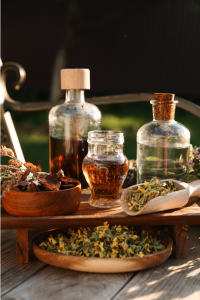
- licorice root – 20ml — anti-inflammatory, adrenal tonic, moistening, mild laxative, reduces androgrens
- white peony root – 40ml — hormonal regulator, cognitive enhancer, anti-inflammatory, bitter for liver, vulnerary (skin and tissue healing)
- holy basil – 40ml — adaptogen, blood sugar regulator, anti-inflammatory, carminative (dispels bloating and aiding digestion)
- bacopa – 20ml — thyroid stimulant, improves mood, bitter for liver, anti inflammatory, supports brain fog
- burdock root – 10ml — lowers blood sugar, reduces inflammation, mild laxative, bitter for liver, cleanse lymph and blood
- white cedar bark – 10ml — cleanses lymph, encourages menstruation, shrinks ovarian cysts
- total = 140ml 7.5ml 2x per day
Standardized capsules:
- milk thistle 150g — liver restorative
- 3x capsules a day
** for this formula I could have done without the white cedar bark and milk thistle to shrink the formula. The hormonal herbs would over time help to dispel the ovarian cyst and there were many liver supportive herbs. However I added those in for even better support.
After about one month she began to have a cycle again and her skin started to clear up. It took about 3-4 months for the issues to start going away — however for anyone with a hormonal imbalance I recommend staying on the formula for 6 months minimum to really allow the body to rebalance.
In summary..
Herbs can be very complex, and while I do encourage and cheer on those who get into the self study of herbalism, I do believe if you want to see more of a full body recovery towards larger health issues, that you do work alongside a practitioner that can help put all the pieces together.
Sometimes one herb is all that you do need! And that is great (and a lot cheaper)! But many times, you do need a correct balance of a herbal formula to really address each and every concern that is going on within the body. As I always tell my clients, the body is like an ecosystem, and it needs to be treated as one rather than one area at a time.
If you have any questions from todays article, don’t hesitate to contact me through the contact page or my email elliesherbalshack@outlook.com . If there is any way that I can help you alongside your herbal journey I would love to be of assistance!
*** this herbal formula is from my own clients experience and being used for educational purposes. It should not be replicated without a herbal practitioner’s advice